Air vs Sea Freight
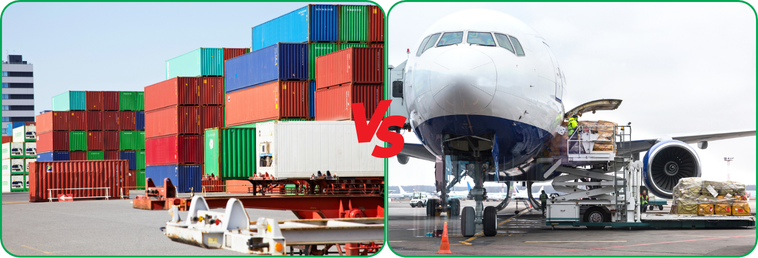
Choosing between air and sea freight isn’t just about moving shipments—it’s about moving your bottom line. Here is the no-nonsense breakdown to help you decide which mode deserves your cargo.
1. Cost (The Bottom Line)
Sea Freight: The undisputed champion of value. If you are shipping heavy machinery, bulk
raw materials, or pallets of non-perishable goods, sea freight costs a fraction of the price
per kilogram.
Air Freight: You pay a premium for speed. Air cargo is roughly 4-5x more expensive than
sea. However, remember that "cost" isn't just the shipping label; air freight reduces
warehousing, insurance (less time in transit), and packaging costs (less crating required).
2. Speed (Time is Money)
Air Freight: The winner. Global deliveries take 1-4 days. This is ideal for just-in-time
manufacturing, high-value electronics, and seasonal fashion.
Sea Freight: The tortoise. Expect 7-60 days depending on the route. While slower, this
allows for better inventory planning and is predictable enough if you have good forecasting.
3. The "Best Use Case" Cheat Sheet
Choose Sea Freight if:
- Your goods are heavy and low-value (furniture, machinery, automotive parts).
- You have a steady demand with 6-8 weeks of lead time
- Sustainability is a priority (sea freight has a much lower carbon footprint)
- Your goods are time-sensitive (pharmaceuticals, perishables, high-end retail).
- You have high-value, low-volume items (microchips, luxury watches)
- You need to restock shelves immediately to avoid a supply chain stoppage.
The New Secret: Hybrid Logistics
Smart businesses aren't choosing one; they're blending both having the best of both worlds. Use sea for the "base stock" (the safety inventory) and air for the "top-up stock" (the emergency restock). This gives you the cost efficiency of the ocean with the agility of the sky.
Final Verdict
If you are shipping 10 tons of furniture, put it on a sea vessel. If you are moving 10 kg of emergency circuit boards, put it on a plane. But if you are trying to grow, don't just look at the shipping rate—look at the total landed cost and your cash flow cycle. The best option is the one that keeps your production line running and your customers happy.
Need a second opinion on your shipping strategy?
Feel free to contact our logistics experts for a free audit of your supply chain.
Published on July 04, 202Published on July 04, 2026
Back to Blogs Comment